Tirzepatide Program
Explore a clinician-guided tirzepatide program through Vea Health. Eligibility, formulation and dosing are determined by the treating provider.
- Medical review required
- Telehealth-based evaluation
- Prescription only if appropriate
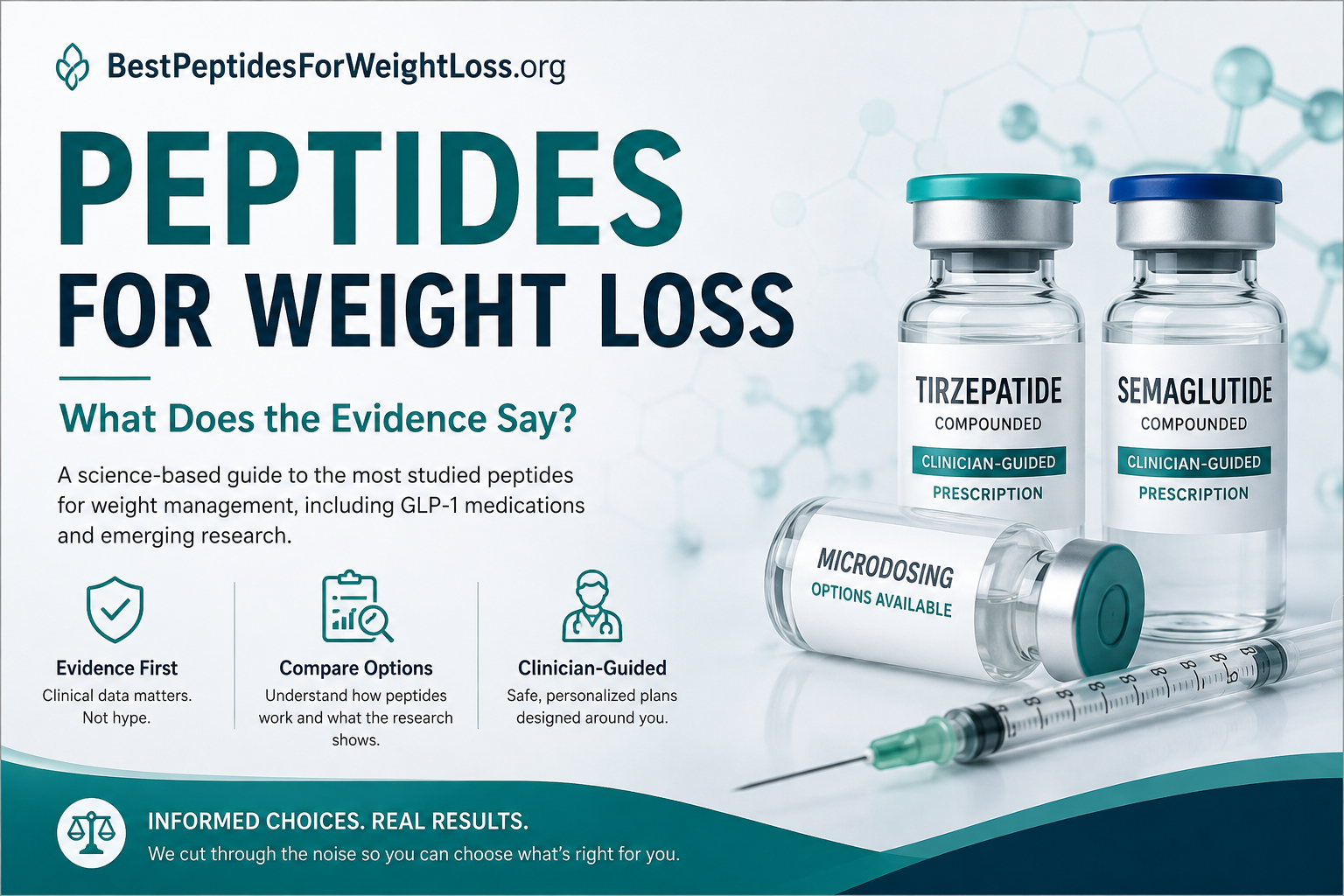
Compare tirzepatide, semaglutide and other peptide-based approaches without the hype. Learn which options have strong clinical evidence, what compounded treatment means, and when clinician-guided care matters.
Prescription treatment is subject to medical evaluation. Not everyone qualifies.
The links below are affiliate links. Vea states that provider approval is required and that its compounded medications are not FDA-approved.
Explore a clinician-guided tirzepatide program through Vea Health. Eligibility, formulation and dosing are determined by the treating provider.
Explore Vea Health's clinician-guided semaglutide option. A licensed provider determines whether treatment is medically appropriate.
Vea also markets a tirzepatide microdosing program. Evidence for GLP-1 “microdosing” as a distinct weight-loss strategy is less established than evidence for labeled regimens of FDA-approved products.
Explore Tirzepatide Microdosing →Vea also offers a semaglutide microdosing pathway. Patients should discuss the evidence, potential benefits, risks and dosing rationale with the prescribing clinician.
Explore Semaglutide Microdosing →Vea markets an oral tirzepatide option for people interested in a needle-free route. Eligibility and treatment decisions require clinician review.
Starting at $280 · Daily oral · No needles
Explore Tirzepatide Oral →Vea markets an oral semaglutide pathway as an alternative to injections. A licensed clinician determines whether treatment is appropriate.
Starting at $180 · Daily oral · No needles
Explore Semaglutide Oral →These offers are separate from the site's core weight-loss comparison. Evidence and regulatory status vary by product. The links are affiliate links, and medical products require appropriate clinician review.
Starting at $120 · Recovery · Nightly injection
Learn about Vea's clinician-guided Sermorelin offering, including eligibility and program details.
View Sermorelin at Vea →Starting at $250 · Recovery · Daily injection
Learn about Vea's clinician-guided BPC-157 offering, including eligibility and program details.
View BPC-157 at Vea →Starting at $269 · Recovery · Weekly injection
Learn about Vea's clinician-guided TB-500 offering, including eligibility and program details.
View TB-500 at Vea →Starting at $251 · BPC-157 + TB-500 · Daily injection
Learn about Vea's clinician-guided Wolverine Stack offering, including eligibility and program details.
View Wolverine Stack at Vea →Starting at $226 · Recovery · Nightly injection
Learn about Vea's clinician-guided CJC-1295 / Ipamorelin offering, including eligibility and program details.
View CJC-1295 / Ipamorelin at Vea →Starting at $100 · Skin · Injection
Learn about Vea's clinician-guided GHK-Cu offering, including eligibility and program details.
View GHK-Cu at Vea →Starting at $250 · Metabolism · Cycled injection
Learn about Vea's clinician-guided MOTS-C offering, including eligibility and program details.
View MOTS-C at Vea →Starting at See Vea · Hair · Topical
Learn about Vea's clinician-guided Hair Growth offering, including eligibility and program details.
View Hair Growth at Vea →Starting at $168 · Energy · Longevity · Injection
Learn about Vea's clinician-guided NAD+ offering, including eligibility and program details.
View NAD+ at Vea →Starting at $139 · Energy · Nasal spray · No needles
Learn about Vea's clinician-guided NAD+ Nasal Spray offering, including eligibility and program details.
View NAD+ Nasal Spray at Vea →Starting at $198 · Antioxidant · Injection
Learn about Vea's clinician-guided Glutathione offering, including eligibility and program details.
View Glutathione at Vea →Starting at $150 · Energy · Metabolism · Injection
Learn about Vea's clinician-guided MIC B12 offering, including eligibility and program details.
View MIC B12 at Vea →Starting at $115 · Men’s health
Learn about Vea's clinician-guided Quattro Men’s Health offering, including eligibility and program details.
View Quattro Men’s Health at Vea →The strongest evidence for clinically meaningful weight reduction is concentrated in GLP-1–based medications studied in large randomized trials.
| Compound | How it works | Weight-loss evidence | Key point |
|---|---|---|---|
| Tirzepatide | GIP + GLP-1 receptor agonist | Extensive randomized-trial evidence for branded Zepbound | FDA-approved branded product exists for chronic weight management in eligible adults. |
| Semaglutide | GLP-1 receptor agonist | Extensive randomized-trial evidence for branded Wegovy | FDA-approved branded product exists for chronic weight management in eligible patients. |
| CJC-1295 / Ipamorelin | Growth-hormone secretagogue pathway | Mechanistic rationale; far less direct human weight-loss evidence | Should not be presented as equivalent to GLP-1 weight-loss therapies. |
| AOD-9604 / BPC-157 | Different metabolic or tissue-repair pathways | Insufficient robust human evidence for standalone weight loss | Marketing claims should remain conservative. |
“Peptide” is a broad term. Different compounds act through different biological pathways, so evidence from one peptide cannot automatically be applied to another. GLP-1 receptor agonists act on receptors involved in appetite, satiety and gastric emptying. Tirzepatide additionally targets the GIP receptor.
Specific branded formulations of tirzepatide and semaglutide have been studied in large randomized clinical trials and have FDA-approved uses for chronic weight management. That level of evidence is substantially stronger than the human weight-loss evidence available for compounds such as CJC-1295, AOD-9604 and BPC-157.
A drug's active ingredient is only part of the picture. FDA approval applies to a specific product, manufacturing process, formulation, labeling and indication. Compounded drugs may be prescribed in certain circumstances, but they do not undergo FDA premarket review for safety, effectiveness or quality.
These are prescription treatments, not ordinary supplements. A clinician should review relevant medical history, medications, contraindications and potential side effects before treatment.
GLP-1–based medications commonly cause gastrointestinal effects such as nausea, vomiting, diarrhea or constipation, especially during dose escalation. Individual risk varies.
Product labeling and clinical guidance include important contraindications and warnings. Pregnancy, certain thyroid-cancer histories, MEN 2, hypersensitivity and other conditions can affect eligibility. A provider should make the determination.
Among peptide-based prescription medications, branded tirzepatide and semaglutide products have extensive randomized clinical-trial evidence for weight management. Other peptides are often discussed online, but their direct human evidence for meaningful weight reduction is substantially weaker.
No. FDA states that compounded drugs are not FDA-approved and are not reviewed by the agency for safety, effectiveness or quality before they are marketed.
No. FDA-approved generic drugs must meet FDA requirements. Compounded drugs are not FDA-approved generics and should not be marketed as the same as an approved product.
The term generally refers to using amounts below conventional treatment or maintenance regimens. The evidence base for microdosing specifically as a weight-loss strategy is less established than the evidence supporting labeled regimens of FDA-approved products. A licensed clinician should determine dosing.
Semaglutide and tirzepatide are prescription medications. Legitimate treatment requires evaluation and prescribing by an appropriately licensed clinician.
This page is educational and was prepared using FDA information and the clinical-evidence summary provided for this site. For current regulatory and safety information, see the FDA's compounding Q&A, the FDA's information on unapproved GLP-1 drugs, and official FDA labeling for approved products.